

When Spots Look Darker After a Holiday: What to Record Separately Before a Laser Consultation
2026/08/24
- Care
- |
- 케어
“I came back from holiday and it feels like these appeared out of nowhere.”
I’ve heard that several times this month alone.
But in most cases, they didn’t appear out of nowhere.
Something faint was already there, darkened under UV exposure, and registered all at once.
So consultations in this season need a question placed ahead of “which laser should we use.”
It’s what type of pigment you’re actually looking at.
When the type differs, so does the device, the number of sessions, and even when to begin.
They may all look like spots, but they are not the same thing
The brown marks that surface on a face don’t share a single name.
- Solar lentigines — well-defined brown patches from accumulated UV exposure
- Melasma — blurred borders, usually spreading symmetrically across both cheeks
- Post-inflammatory hyperpigmentation — marks left where acne or a wound healed
- Freckles — present since childhood, darker in summer and lighter in winter
To the patient, they all read as “spots.”
The approach for each is different.
Melasma is sensitive to stimulation, and pushing too hard can bring it back instead.
Solar lentigines, by contrast, tend to settle in relatively few sessions.
Bundle the two into one plan and one of them loses out.
Starting right after summer isn’t always the advantage it seems
I understand the urge to begin immediately.
But skin that has just taken a lot of UV can be more reactive than usual.
Put strong energy into it in that state and the pigment may not clear — instead, pigment can be left behind after the irritation.
In these cases I switch the order around.
First calm and hydrate to settle the skin, then look at the pigment.
I’ve seen better outcomes several times from settling things for two or three weeks and then starting, rather than rushing in and having to do the work twice.
And pigment doesn’t clear in a single pass.
It’s closer to fading it over several sessions.
Four things to record separately before your consultation
To build a precise plan in a short consultation, it helps a great deal to write these down separately and bring them in.
- Since when — did it first appear this summer, or was it already there and simply darkened
- Where — cheekbones, forehead, or beside the nose. Symmetrical on both sides, or one side only
- UV history — how often you were outdoors this summer, and whether you reapplied sunscreen
- Recovery window — when you could tolerate crusting or redness for a few days
I ask about the fourth one especially.
Depending on the type, a pigment laser can leave visible marks for several days.
If an important occasion is close, we build the plan with a different device and intensity.
Photos help even more.
Compare a picture from last summer with today and the pace of change becomes visible.
Aftercare matters as much as the treatment
To be straightforward with you: pigment comes back if it isn’t managed.
Even after a laser has faded it, continued UV exposure often brings it back to the same place.
That’s why I spend as long explaining aftercare as I do the treatment plan.
With melasma in particular, I consider aftercare more than half of the work.
Many patients come to the Seocho branch from overseas. When a stay is short, rather than forcing several sessions in, we separate what we’ll do this time from what we’ll do next time.
Frequently Asked Questions (FAQ)
How do I tell spots and melasma apart?
Well-defined marks scattered individually point toward solar lentigines; blurred borders spreading across both cheeks point toward melasma. The two are often mixed, though, so we confirm it together during the consultation.
Can I have a laser right after a holiday?
Just after heavy UV exposure, skin can be in a reactive state. Depending on the condition, settling it for two or three weeks first can be better, so we confirm where your skin is now and decide the timing together.
Can it be cleared in one session?
Pigment tends to fade over several sessions rather than clear in one. The number needed varies with type and depth, so we walk through it in the consultation.
Will there be crusting or redness afterwards?
Depending on the device and intensity, marks can be visible for a few days. If an important occasion is near, we adjust the approach to fit it.
Pigmentation after a holiday usually isn’t new — it’s something that was already there and has darkened.
Separating which type of pigment it is, and whether your skin is in a state to begin, is the right order.
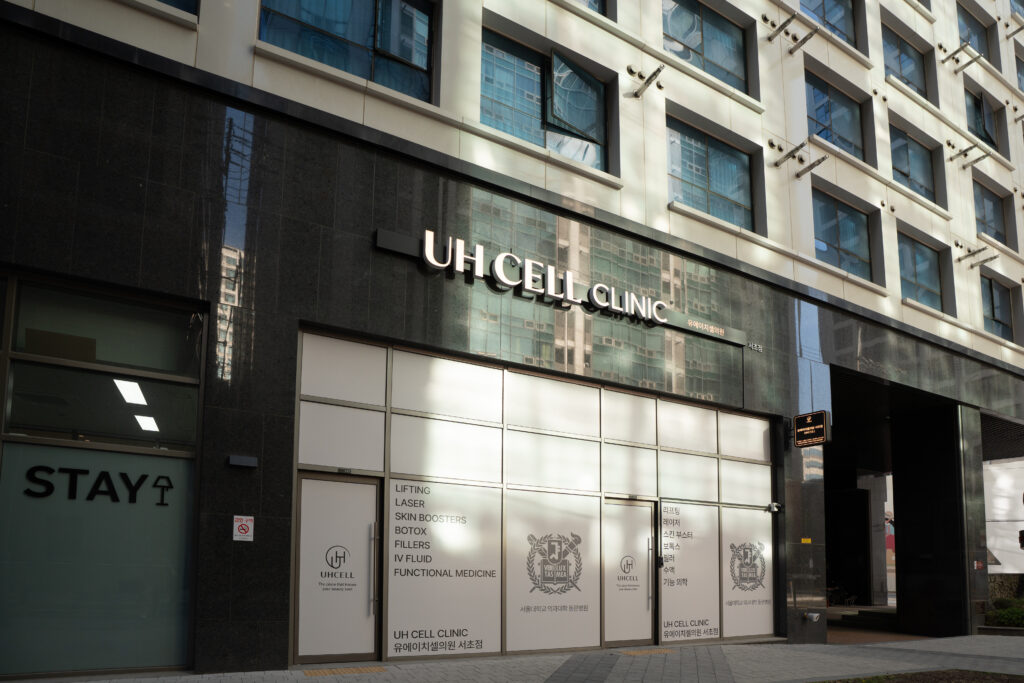
At UHCELL Clinic Seocho branch, we confirm the type of pigment and the condition of your skin, then separate what we’ll do this time from what we’ll do next.
※ Individual results and recovery periods may vary. We recommend consulting a specialist for an accurate medical diagnosis.
This was Dr. Kim Kyung-soo, Medical Director of UHCELL Clinic Seocho branch.
Native English, Japanese, and Chinese speakers are on staff, so communication is smooth.
Parking: available on levels B2 through B5 of the same building, with 2 hours of free parking registration.
To book an appointment at UHCELL Clinic Seocho branch, please contact us by phone or through our website.
UHCELL Clinic Seocho branch: 1F, 30 Banpo-daero 16-gil, Seocho-gu, Seoul (439m from Exit 6, Nambu Bus Terminal Station)
tel. +82-2-2135-4393